
Part 1 OpenAI Daybreak Explained: Two Routes for Cybersecurity Professionals
Individual guardrail uplift, organisational access, and where Codex Security fits

In Part 1, I am breaking down the different routes into OpenAI’s cyber programme and what each one is designed for. In Part 2, I will show you what happened after I was admitted, run Codex Security against an authorised codebase, and explore what the cyber capabilities can actually do.
OpenAI’s cyber announcements are easy to mix together.
There is Daybreak, Trusted Access for Cyber, Codex Security, and a specialist cyber model. They are often discussed together, but they are not the same thing and you do not need to join an enterprise programme just to begin scanning code that you own.
The simplest way to understand the current setup is:
Individuals can verify their identity to receive trusted access for legitimate security work. I think of this as a cyber guardrail uplift.
Organisations can apply for managed Trusted Access across an approved internal workspace.
Cybersecurity vendors and service providers can apply to the Daybreak Cyber Partner Program.
Codex Security is the tool that brings the find, validate, patch and verify workflow into Codex.
What is OpenAI Daybreak?
OpenAI Daybreak is the umbrella programme. It brings together OpenAI’s cyber-capable models, Codex Security, Trusted Access for Cyber, Patch the Planet, and partnerships with cybersecurity companies and public institutions.
The goal is not simply to find more vulnerabilities. Security teams already have scanners generating long lists of possible problems. The harder questions are:
Is the vulnerability real?
Can an attacker reach it?
What is the actual impact?
Can we produce a focused patch?
Does the patch stop the issue without breaking the application?
Daybreak is designed around that complete remediation loop.
Find the vulnerability → validate it → understand the impact → generate a focused patch → test the fix → hand the evidence to a human reviewer. This is the important shift. A vulnerability report does not protect anyone by itself. Protection comes when a validated fix reaches production.
Why does cyber access work differently?
Cybersecurity is a dual-use area. The same model that helps a defender validate a vulnerability could also help an attacker. A prompt such as “find vulnerabilities in this application” does not prove whether the person owns the application or is preparing to attack it.
OpenAI therefore uses safety training, automated monitoring and cyber-specific guardrails. Those controls are necessary, but they can also interrupt legitimate research when the system cannot confidently distinguish defensive work from misuse.
Trusted Access for Cyber is designed to reduce that friction for verified defenders while keeping safeguards, monitoring and usage policies in place.
There are two practical access routes.
The human remains in control. Codex can gather evidence and propose a change, but the reviewer still decides which findings are credible, which patches are acceptable and what information can be shared.
One point is worth repeating: you can begin with a standard defensive scan of an authorised codebase without first obtaining the most specialised cyber access. Trusted Access becomes relevant when legitimate work requires advanced analysis and would otherwise encounter unnecessary cyber guardrail friction.
Which route do I need?
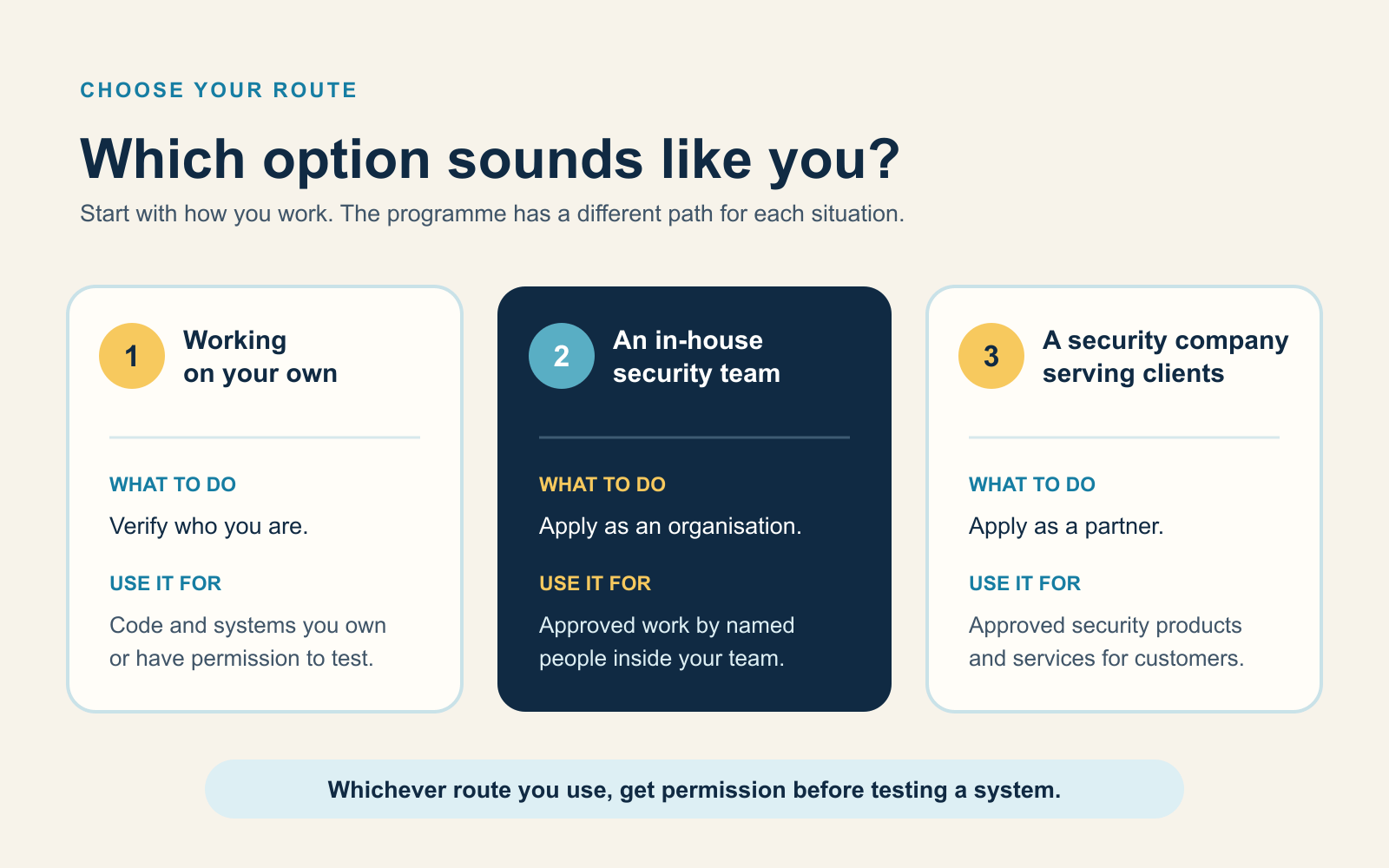
I want to scan code that I own
Start with the Codex Security plugin and run a standard defensive scan.
I am an individual and legitimate cyber work is hitting unnecessary guardrail friction
Complete the individual verification process at chatgpt.com/cyber.
My internal security team needs managed access across an organisation or API workspace
Use the organisational Trusted Access application or speak to your OpenAI representative.
My cybersecurity company wants to deliver Daybreak-powered services to customers
Explore the Daybreak Cyber Partner Program.
I want access to the specialist cyber model
Apply through the relevant Trusted Access route. Approval for specialised model access is separate and is not guaranteed simply because identity verification has been completed.
Coming next: I was admitted - so what can it actually do?
Understanding the programme is useful, but the more interesting question is what the experience looks like once access has been approved. In Part 2, I will show you my own experience after being admitted to OpenAI’s cyber programme. I will cover:
what the verification and admission process looked like;
what changed—and what did not change—after approval;
how I set up an authorised test repository in Codex;
my honest view of where the capability is genuinely useful today.
Continue to Part 2: Inside OpenAI’s Cyber Programme What Trusted Access Can Actually Do? (Part 2 coming soon)
References
Daybreak: Tools for securing every organization in the world
Trusted Access for Cyber overview
Individual Trusted Access verification
Organisational Trusted Access application
Daybreak Cyber Partner Program
Get started with the Codex Security plugin
Have blog ideas, want to engage on a topic, or explore collaboration? Let’s take it offline reach out on LinkedIn. I’d love to connect and continue the conversation!